
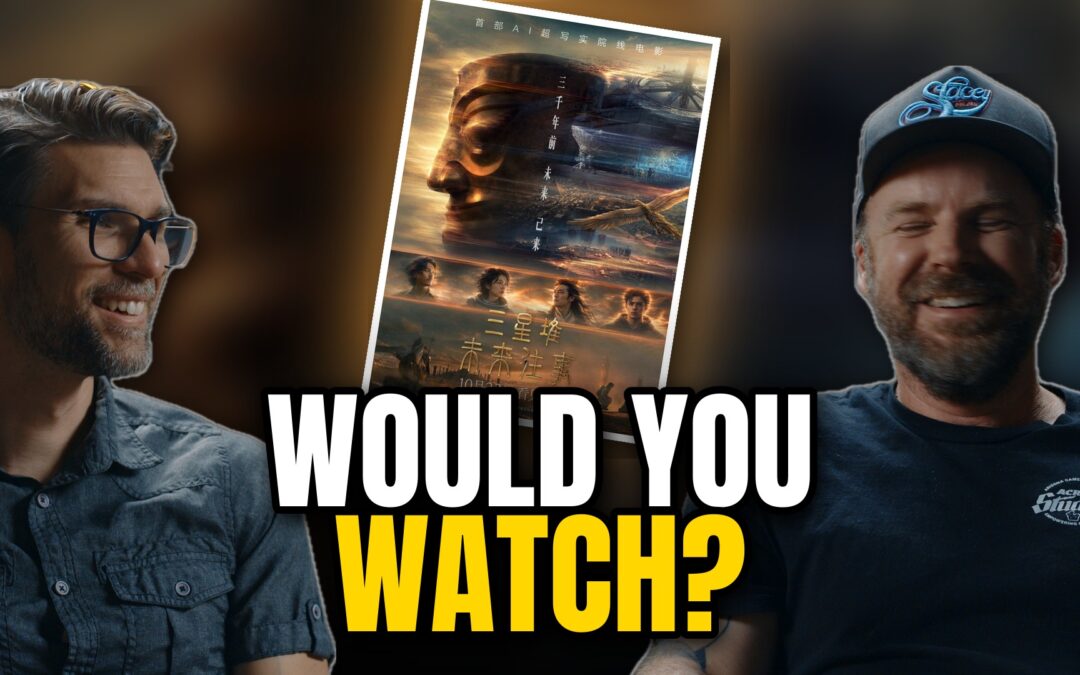
I’ve never been happy to see a movie bomb. However, that changed with the release of a feature made entirely with AI that just played in real theaters in China. Almost nobody showed up to see it. There isn’t a filmmaker reading this who isn’t familiar with the balancing act between art and budget. Today we have a new shiny tool that promises to make everything a bit more affordable. But if this tool also shows negative returns (catastrophic in fact), is it worth it?
Sanxingdui: Future Past, from Bona Film Group, opened in Chinese theaters on October 23, 2026, and its producers call it China’s first fully AI-generated theatrical feature. Bona says it cost more than RMB 10 million (about $1.5 million) and took nearly 100 people more than two years. Estimates put its gross at RMB 1.21 million, about $181,000, through Monday, October 26. Cartoon Brew’s later count was roughly $253,000 after 11 days, with a second-weekend drop of 60% or more. Cartoon Brew opening report · Cartoon Brew second-weekend report · TechNode release announcement
How bad was it?
This was not a small release that nobody could find. China’s a big market. And Sanxingdui debuted with over 10,000 screenings scheduled for opening day (A little more than my first movie. Ok a lot more than my first movie…). Spread over those showings, $181,000 comes to less than $20 a screening. Cartoon Brew opening report
I’m against AI as a way to make generative art. However, putting on my “objective hat” if I were to incorporate AI in any way, I would still use real actors for genuine human performances that still can’t be replicated. However, the Chinese filmmakers chose not to do this. TechNode reports that the film’s characters are original digital creations, not replicas of real actors. A 36Kr writer who saw it in a theater reports an on-screen notice saying all of the visuals and part of the dubbing were generated by AI. So the faces were generated, and so were some if not most of the voices. TechNode release announcement · 36Kr review of the film
A hundred people spent two years making this movie. I also wonder how much water they used making that movie. My guess is a lot more than a crew with water bottles. (Actually they still had a crew so they had people drinking water AND computers drinking water)
None of it has scared the studio off. Cartoon Brew, citing Investment Times, reports that Bona has another AI sci-fi animated feature in production and a mythology-themed animated project in development. Cartoon Brew second-weekend report
But 95% of China’s verticals are AI and those are cash cows?
Aiden Chapparone pointed out that people there are watching verticals, and that over two-thirds of them are full AI. The real share is even higher. Caixin reported that about 122,000 of roughly 128,000 microdramas released in China in the first quarter of 2026 were AI-made, which is over 95%. Caixin on AI microdramas
The vertical hit was a different project: Bona’s earlier AI-made Sanxingdui short series on Douyin, with episodes of about three minutes, which Caixin counted at 140 million views after its July 8, 2024 release. So the same studio and the same subject pulled 140 million views in three-minute pieces, then about $181,000 in theaters. Aiden’s guess is that people are more willing to watch AI on their phone than in a theater, and those two numbers make his case. Yicai on the Douyin series · Caixin on AI dramas
Here’s my read on why it flopped: short AI content on your phone is more of a curiosity at this point. You watch it and think, it looks so good and it’s technically right, but why is it so bad? It’s a novelty more than anything, and a novelty is fine for a minute while you’re scrolling. But I don’t want to go watch a two-hour novelty. I want a story with characters and real people.
The catch is that plenty of people can’t tell. With my family, I’m the AI filter. They forward me stuff asking if it’s real, and I tell them no, it’s not. How did you even get fooled into thinking that was real? People get fooled by that sometimes now, and I feel like it’s going to get worse.
Where AI might belong on a real set
A flop in theaters doesn’t keep AI out of production. The rise of the greybox technique is intriguing, and several of our friends are making movies that way right now. Is there a way forward if we’re still telling human stories with real humans and real human emotion?
A gray stage is close to what it sounds like. Doug Liman shot Bitcoin: Killing Satoshi in 20 days in London inside what the producers call “the gray box,” a bare room with walls covered in tracking marks, and the lighting, environments and backgrounds are being generated by AI in post. The producers say that took the budget from over $300 million down to $70 million, a figure No Film School notes is hard to verify. Aiden pointed out that gray stages are being pitched as a replacement for set dressing and stuff like that. No Film School on the gray box shoot
I’ve seen multiple examples of this. In one sample, two dudes in helmets are on a moped, and nobody had to put them on a process trailer, the low trailer that tows a vehicle so actors can play a driving scene while the camera rides along. They’re just sitting there. That specific example still looks pretty fake to me. Skipping a process trailer would be a real saving on a driving scene, but only if the shot holds up.
There are versions getting better, where you don’t need a virtual wall, meaning an LED volume, for a full replacement. Then there’s using it for set extensions, where you do most of the work practically and use AI to help out with some of it. That version still has real people on a real set.
So, would I watch a full AI movie?
No. For two hours in a theater, I want a story with characters and real people.
Where I’d actually welcome AI is the business side. I can’t wait for AI to do the movie accounting. Could AI just get us paid on time? Seems like a computer could help with that. Don’t change the creative roles. Figure out how to get us paid on time, and then we’ll be happy. Ok, I’ll get off my soapbox… My apologies to the movie accountants in the room.
AI is here and there’s no putting the genie back in the bottle. But what AI tools are acceptable and which ones are not? Which ones won’t chase your audience away?
Planning a shoot with real people on a real set? Browse ACR’s camera and grip rentals or book a stage at ACR Studios. Would you watch a full AI movie, and what do you think the future of AI and filmmaking is?
Watch the full podcast episode on youtube